1. Executive Summary
Nigeria’s oil wealth has played a central role in shaping the country’s economic and political development. Yet, despite generating enormous revenue, oil exploitation has produced severe environmental degradation, social conflict, and economic inequality in the Niger Delta region. This study examines the complex relationship between oil production, environmental destruction, and violent conflict, conceptualized as “petro-violence.”
The paper situates the Niger Delta crisis within the broader framework of the resource curse, where countries rich in natural resources often experience slower economic development, weak institutions, and political instability. In Nigeria, oil wealth has fostered rent-seeking behavior, corruption, and the concentration of economic benefits among political elites, while local communities in oil-producing regions remain impoverished and environmentally devastated.
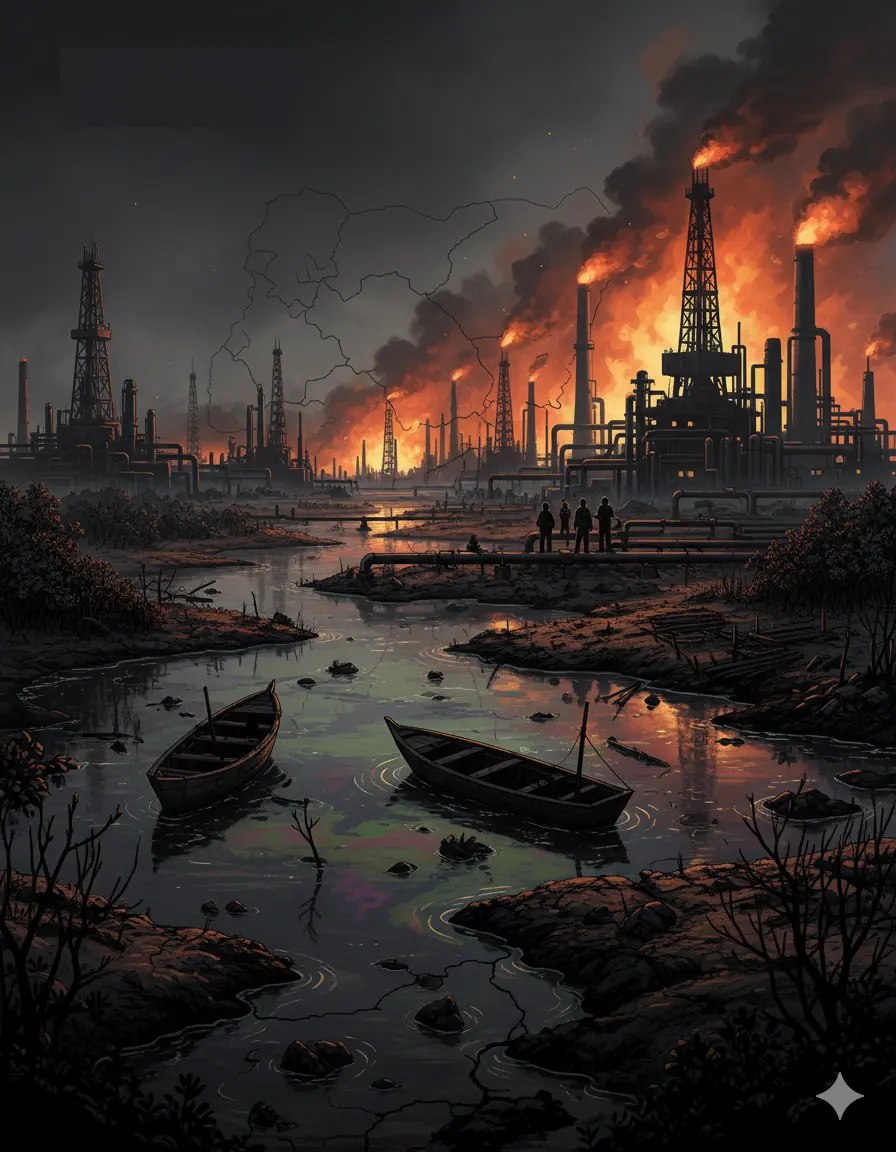
The research highlights how decades of oil exploration have contaminated farmland, rivers, and ecosystems through oil spills, gas flaring, and pipeline explosions. These environmental impacts have destroyed traditional livelihoods such as farming and fishing, intensifying poverty and fueling youth militancy and violent conflict in the region. The study argues that petro-violence is not simply a security issue but a systemic outcome of governance failures, inequitable resource distribution, and unsustainable resource exploitation.
The paper contributes to broader discourse on environmental governance, development systems, and resource-based conflict, offering insights relevant to policymakers, development practitioners, and researchers working on sustainability, governance, and resource management.
This report is designed primarily for:
❖ Policymakers responsible for natural resource governance
❖ Environmental and energy policy institutions
❖ Development practitioners working in resource-rich economies
❖ Researchers in political economy and environmental governance
❖ Civil society organizations advocating environmental justice
❖ International organizations working on sustainable development
❖ Institutions addressing conflict and resource management in developing countries
2. Methodology & Analytical Framework
The paper adopts a conceptual and political economy analytical framework, drawing on theoretical perspectives and case-based insights.
The analytical approach includes:
- Political economy analysis of oil extraction, examining power relations and resource control
- Environmental governance analysis, focusing on regulatory frameworks and institutional capacity
- Case-based examination of oil-producing communities in Nigeria
- Development systems perspective, linking environmental degradation to livelihoods and socio-economic outcomes
- Conflict analysis, assessing the relationship between resource exploitation and social instability
This framework enables a structured understanding of how resource governance and institutional dynamics influence environmental and development outcomes.
3. Key Insights & Major Findings
1.Oil extraction contributes to environmental degradation and socio-economic instability in affected communities.
2.Weak governance and regulatory failures enable environmental harm and resource conflict.
3.Resource control and benefit distribution are central to understanding petro-violence.
4.Environmental degradation directly impacts livelihoods and economic sustainability.
5.Integrated governance approaches are necessary to address resource-related conflicts.
6.Development systems must incorporate environmental and governance dimensions to achieve sustainability.
Author :
Dr. Chijioke J. Evoh
Publication Date : 2009
PDF Size : 298kB
Page Count : 13
Policy Domains Covered
Natural Resource Governance
Environmental Policy
Energy Policy
Conflict and Security
Sustainable Development
Environmental Justice
Political Economy
Resource Management
Community Development
Economic Diversification
Development Systems
Sustainability Policy
Explore related work on employment policy and labour market systems advisory


.webp)